
“We never remember the moments our pictures are taken. We think we do, but we don’t. Photographs do not reflect the turbulence underneath.” – Kate Zambreno (The Book of Mutter, Semiotext(e), 2017)
Can We Trust Our Memories If They Are Photographs?
I compulsively take photos of life events, recording experiences both rich and trivial. I may photograph book passages (for referencing later or sharing on social media) as a way of remembering the ideas. I often take photos of family, like this past weekend, when two family members graduated from their respective degree programs. I somehow believe intuitively that this will help me to recall these events later. But, I am reminded of Barthes and Sontag’s discussions of memory of photographs themselves as being the end result. We don’t remember the moment as much as the photo itself. The photograph allows the individual to construct a memory around it. The photograph becomes a way of seeing the world and collecting it for our own reconstruction. In this way, taking photos isn’t experiencing the moment as much as it is a cataloguing of it. We are shutting our eyes and allowing the camera to see for us.
This compulsive photography is not uniquely associated with my own personal relationship with the world. At this point in history, it seems that most phone apps are photography-based. Instagram and Snapchat are the touchstones for many, but even Facebook is based in the personal profile, which is essentially photography. Facebook has even leveraged, like so many others, the live video feature so that users can broadcast whatever they like whenever they like. We are enveloped in image-based media. I would add that all of us, in trying to explain what we have viewed (ekphrasis in its simplest form), reduce the complexity of imagery to language that fails to accurately capture the intellectual, emotional, or aesthetic dynamics at play. Thus, we resort to simplified images with simplified descriptions, like memes. We become disconnected from one another and unable to imagine our own ending and resurrection in the other. This is one of the foundational pieces of Byung-Chul Han’s (The Agony of Eros, The MIT Press, 2017) essay. In this work, he presents a compelling case for how and why this world of images only helps to disconnect us from one another.

If We Don’t See The Other, We Can’t Love The Other
Han describes the act of photography as “the inner music of things sounds only when you close your eyes. Roland Barthes quotes Kafka in this context: ‘We photograph things in order to drive them out of our minds. My stories are a way of shutting my eyes.’ Today, faced with the sheer volume of hypervisual images, we can no longer shut our eyes.” Due to this “excessive openness and unlimitedness,” our imaginations have suffered, and we have no way of conceptualizing an other. Han assures us that to love would mean to lose ourselves in the perspective of the other. This allows us to conceptualize the other through our relationships. This seems to be true. There are thousands of examples in the humanities, but the centennial of the birth of poet Gwendolyn Brooks is coming soon…so, here is this. However, Han is arguing that we are instead losing ourselves in ourselves. This narcissism is supported and rewarded in our world.
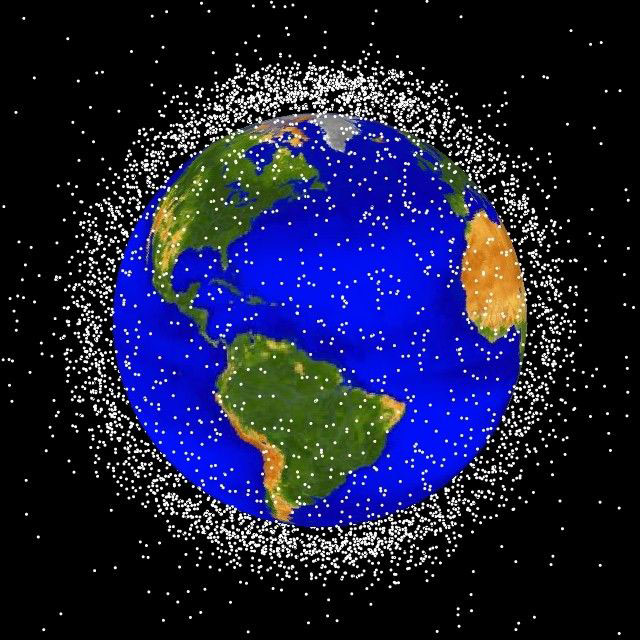
The images we are seeing all around us seem to be based mostly around data and economics, and this leaves us with no “other” with which we may view new perspectives and understandings of the world. The visual images are constructed for us to see ourselves (or our closest analogue), thereby making everything the same. This massive normalization ends the need for an other, and it destroys the possibility for imagination or fantasy. The other disappears completely in Han’s line of thought. Han describes this impact (in social and artistic arenas) as the agony of eros. On an individual level, one that is submerged in this narcissistic and empty reality is bound to never reach conclusion on anything. (There is a link in my mind here to Julia Kristeva. In Black Sun: Depression and Melancholia, Kristeva echoes this idea of depression- as one unable to bring anything to conclusion- as the loss of language and identity. The language is repetitive. The actions are repetitive. There is no breaking the cycle, leading to an existential crisis. The images fragment us, leaving language and imagery as disparate chunks of information that resemble the detritus of life, the leftovers.)
Is this all we have? Is this what life has become? Is this new form of “capturing images” doomed to create a stronger separation between individuals?
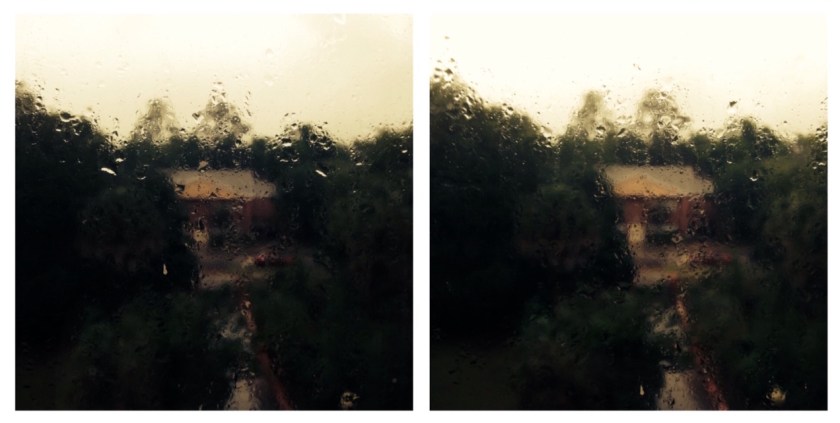
Norman Hall, 2013
Memory and Photography
I can’t help but consider Guibert’s own failed photography of his mother. His essay, Ghost Image (1996), reconstructs the act of taking these photos, only later to learn that it had failed to capture any of the images. Guibert still has this remembrance of his mother, her freedom away from his domineering father, her smile and happiness. He viewed it all from behind the camera lens, separated by the lens from the subject. The emotional engagement and intellectual stimulation persists. I think of this as a counter argument to Han’s conceptualization. I know that Han is speaking mostly of photography in the social media age, but is it all based in the ego? Does there exist a version of this image capture that actually brings people together? Like most things, it must be both. The same activity and ancillary activities (sharing, posting, etc) can have positive and negative impacts on individual minds. Is memory always negatively impacted? I think Guibert describes his failure to capture this moment with his mother as the negative, and he is growing through the reconstruction of the events in his mind.
Maybe the speed at which information is moving (see Paul Virilio for theorist interested in image sharing, speed, and its impact on our understanding), our ability to process memories may not be able to keep up, leaving us to move from thought to thought. This fragmentation may be the real issue with which we are faced.
I Have Only What I Remember
In Latin, the term loci means places. Method of loci was a means of creating a spatial “place” in one’s mind to catalogue and retain memory. Memories could be organized like rooms with furnishings. In this manner, one could create an entire palace of rooms with all of the knowledge they had acquired throughout their life. In Han’s description of photography above, it only serves to divorce one from their memory-making by letting the camera/phone do the work. This is light years away from Kaja Silverman’s (The Miracle of Analogy, 2015) conceptualization of photography as the discovery that expanded our language, forever including captured images as part of the grand dialogue.
This deep vocabulary of image and text is best captured by the relatively new word, multiliteracies (The New London Group, 1996). The multiliteracies are familiar to any educator as a cornerstone of most learning standards, including the Common Core Standards. Perhaps, these varied visual-textual communication activities are more positive in their ability to connect us organically.
Either way, there is something to the idea of being in the moment that is lost in the speed of modern communication, and there is something we may be losing from not building our memories through experiences. The reliance on apps for instant communication may let our minds rest a little too much. Only time will tell if this new visual-rich culture will make us all empty narcissists with no memories.
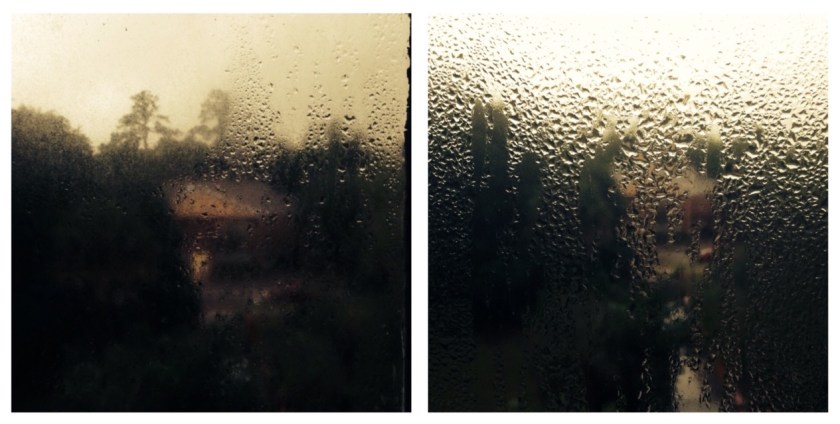
Norman Hall, 2013
After thought- Fragment As Thought / Fragment as Compositional Element
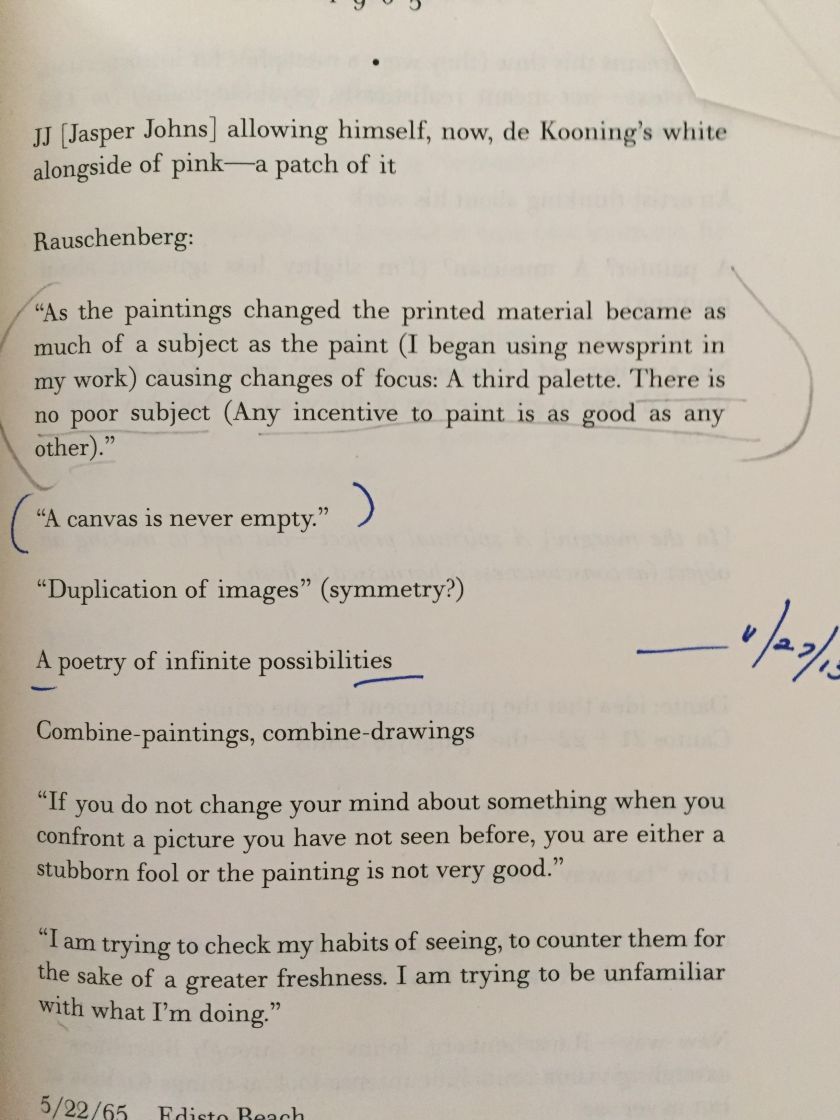
In my view, something about this fragmentary existence can be see as a positive. Assemblages can be a kind of superstructure for the craft of storytelling when we want to bring in the complexity of multiple perspectives. Autotheory, a hybrid of autobiography and critical theory, has proven to be well adept to capturing the language of the moment. Some recent examples include Maggie Nelson’s The Argonauts (2015) and Kate Zambreno’s The Book of Mutter (2017). Nelson adapts Barthes’s citation method, pulling the actual citations out of the text itself and allowing the reader to become immersed in the actual story. Zambreno works with the fragment in an organic and effective way, also bringing in photos from film and her mother’s past. There is probably no other writer doing this as effectively today. Other touchstones for this methodology include Bhanu Kapil (specifically Ban en Banlieue, 2015) and Jenny Offill (Dept. of Speculation, 2014). The works that are constructed from image and text are the most powerful for me, like Camera Lucida (Barthes, 1981).
In these, the authors are always reaching for what is unable to be effectively described using traditional narrative forms. The fragment becomes the tool for analysis of memory and understanding. I eventually always end up discussing the unknown and the importance of the embrace of the unknown. Many times, this is based on my interest in fragments. From Hadrian’s only written work to endless revisions collected for viewing to Sapho to Decasia and broken thought or erasure, I am interested in fragment (and the fragmenting of the whole) as compositional style.
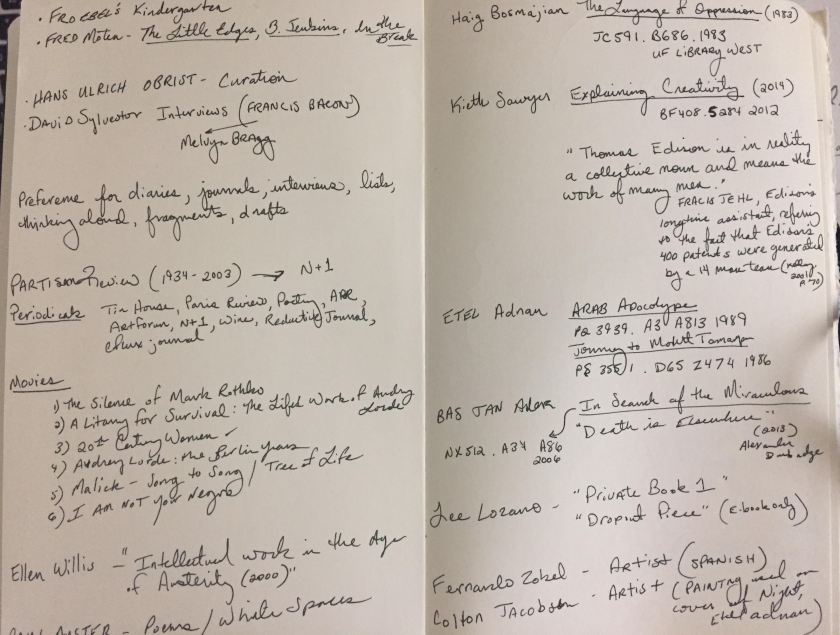
Even this post was improvised and completely a surprise. I had no idea where it was going, but I have been thinking about all of this and so much more. There is little time and so much to consider. These are just transparent notes that may find themselves into something else, in another form.
This evening, I took a photo of Eleanor having a pretend tea party. I shared this, knowing her parents and my parents would see it and smile. I suppose I shared it, because I wanted that connection…to nurture our love for one another.
Note- The alternative title of this post is taken from Zambreno’s The Book of Mutter, 2017. The phrase, I have only what I remember, is from W. S. Merwin’s poem, “A Likeness” (The Shadow of Sirius, 2008). The image is a photograph of my brother, sister, and me from 1980. The televisions, stacked in the background, were apparently equal subjects to capture.









 Dr. Jason Dean Arnold