Via Braincraft and Explore.
Month: January 2014

Wall, parking garage, reflecting my mood
Notes on Dreaming and Creativity, Intelligence, and Recall
*Does dreaming and the recalling of dreams suggest anything about the individual? More specifically, does dreaming explain anything about the adolescent mind?
I read a couple of studies take this question.
First, Dr. David Watson’s study, from which this extended quote is derived:
“What gives rise to these individual differences in dream recall? Much of the research in this area derives from the salience hypothesis. This hypothesis represents a natural extension of the more general cognitive literature on the processes that influence the recall of information (see Cohen, 1974; Goodenough, 1991). Salient stimuli—for example, items that are novel, intense or unusual— are more easily remembered. Dreams also conform to this general pattern; thus, considerable likely to be remembered (Cohen, 1974; Goodenough, 1991). For instance, Cipolli, Bolzani, Cornoldi, de Beni, and Fagioli (1993) classified dream content as either bizarre or nonbizarre, and found that the rate of delayed recall for the former was approximately twice that of the latter. Extended into the realm of individual differences, this model posits that people who tend to have more memorable dreams—that is, dreams that are highly vivid, intense, unusual, and interesting—should show better overall recall. This basic idea has received broad support. This evidence comes from two interrelated lines of research. The first line emphasizes the normal and adaptive aspects of dream recall, and is based on a continuity model of human consciousness (Blagrove & Hartnell, 2000; Claridge, Clark, & Davis, 1997; Goodenough, 1991) . This model assumes that people who have interesting, vivid and unusual experiences during the day—for instance, those who are highly creative, imaginative, and prone to fantasy—also will have more salient and memorable dreams and, hence, show better dream recall.”
Then, there is this wonderful study with a larger sample size (5,000+), led by a team from the University of Basel (Switzerland). The following is quoted from the abstract:
“Results: As compared with males, female adolescents reported a higher dream recall rate and felt a stronger impact of dreams on the subsequent day. Female adolescents also described themselves as more creative, and reported suffering more from sleep complaints and perceived stress. Multiple regression analyses further revealed that increased dream recall was independently predicted by factors such as female gender, sleep quality, and creativity, whereas perceived stress, awakenings during the night, and sleep duration had no predictive value.
Conclusions: Similar to the findings of studies conducted on adults, dream recall was also associated with female gender in a large sample of adolescents. Additionally, it seemed that several different factors such as good mood, increased sleep quality, and creativity influenced dream recall. These results can provide a basis for better understanding the psychology of dreams in adolescence. In contrast to nightmares, recalling dreaming is associated with health and well-being.”
If one has the time, it may be beneficial to seek out the following studies:
- Schechter N, Schmeidler GR, Staal M. Dream reports and creative tendencies in students of arts, sciences and engineering. J Consult Psychol 1965; 29:415–21.
- DeCicco TL. Dreams of female university students: Content analysis and the relationship to discovery via the Ullman method. Dreaming 2007;17:98–112.

Image- Leonardo Da Vinci, c. 1508
Fragment of a poem about my wife
*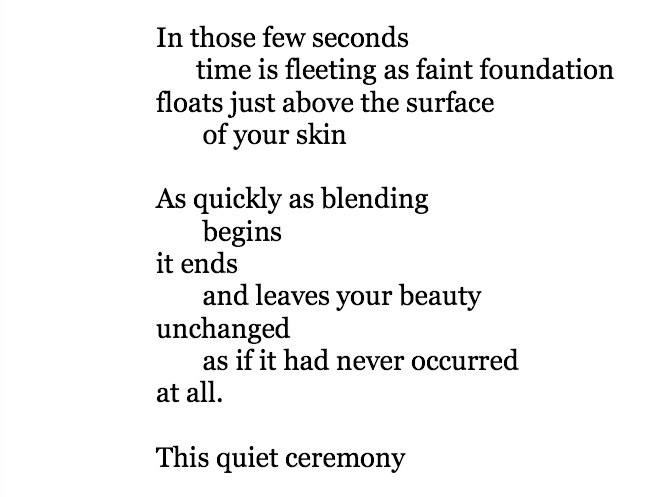
Mornings, make-up.
Links Related to Poverty & Opportunity in Education- My Notes
*Random links related to my thoughts on poverty and access to opportunity in education. This is completely random, and I collected studies along the way. I will attempt to produce a cogent thought at some other point. For now, here are some notes.
Do you believe that every human being deserves an opportunity to learn, to become an informed citizen of the world?
Do we treat the symptoms of the issue or the issues at the root of the problem?
“To critics of the reliance on standardized testing, the problem is a matter of emphasizing the wrong metrics. Equal access to high quality education, they argue, is the key to improving student learning.’We’ve been focused on test-based accountability, but testing does not equal accountability,’ Linda Darling Hammond, a professor of education at Stanford University, said at an event on the results in Washington on Tuesday. ‘Accountability is when you have a system that works for each and every child.'”
– Maya Rhodan (Read the article at this Link) on PISA results in Time, December 2013.
October 2013 Washington Post Article on SAT scores and socio-economic status
2009 NY Times Article on SAT and socio-economic status
In her dissertation Linda Ruth Williams Sorhaindo (2003) examined a sample of 9,000 4th and 8th grade student achievement scores in the Miami-Dade Public School system. She compared student scores and tested to see if there was a relationship between degree of poverty and academic achievement test scores. Read more here.
Check out Jeremy Allan Moore’s (2011) dissertation correlating poverty and student achievement scores in Florida here. Hint from his abstract-
“This study was successful in quantifying correlations between poverty and student achievement in Florida by utilizing FRPL as a proxy for poverty and FCAT as an indicator of student achievement. Correlation results ranging from -0.761 to -0.855 demonstrated strong associations between these variables. Over the span of years observed, as poverty levels increased in Florida schools, 76 percent to 86 percent of the corresponding student achievement scores decreased. These connections provided measured relationships between poverty and student achievement.”
Moore (2011)
Fragment of one of my poems about my grandfather
*
This small piece – I liked it.
Just a fragment, but it was my favorite part.
Bergman Quote, 1964
*Why make art? Why write or photograph or paint anything?
“If you can take that first step toward communication, toward understanding, toward love, then no matter how difficult the future may be- and have no illusions, even with all the love in the world, living can be hellishly difficult- then, you are saved. This is all that really matters, isn’t it?” – Ingmar Bergman, 1964


Winter blue and brown

Last night, the sky painted itself electric.
Recent Publications (since December 2012)
*
UPCOMING PUBLICATIONS, 2014
“Revisionism” at 5/Quarterly’s Tumblr in Spring 2014
“Wetlands” at Convergence: An Online Journal of Poetry and Art (Spring/Summer’14)
RECENTLY PUBLISHED POEMS, 2012-2013
“Occupation” at Convergence: An Online Journal of Poetry and Art
“Broken Consort” & “Silent Black Song” at Icebox Journal
“Amplifier” at NNATAN
Three Poems at Iridum Sound’s Churn Thy Butter
“Haunting” at Yorick Magazine, Summer/Fall 2013 Issue
RELATED
Painting and Process (short interview) at Draft Journal, 2013


Our beautiful girls. @annamaria0717

Piece of a poem I wrote to Anna in April, 2011.
Creativity and Dr. Dorothea Lasky – Links and Appreciation
*Dorothea Lasky is a force for creativity.
Her poems burst with color and neccessity. Her short lines are full of fire. Earth, water, and wind are present in her most recent book, but there is much fire.
Not only a respected and established poet (her books- Awe, Black Life, and Thunderbird- can all be purchased at Wave Poetry), Dr. Lasky examines the role of creativity in learning. Her dissertation, her articles for academic journals, and her class syllabi all reflect this deep passion for the creative act. She creates spaces in her writing and her teaching that allow others to experience the power of the imagination and the possibility of experiencing something transcendent.
But, you can read for yourself.
Here is a small list of some of her articles, interviews, and her book on poetry in education:
Could Poetry Start an Educational Revolution?
Open the Door: How to Excite Young People About Poetry
Making Space for the Act of Making: Creativity in the Engineering Design Classroom

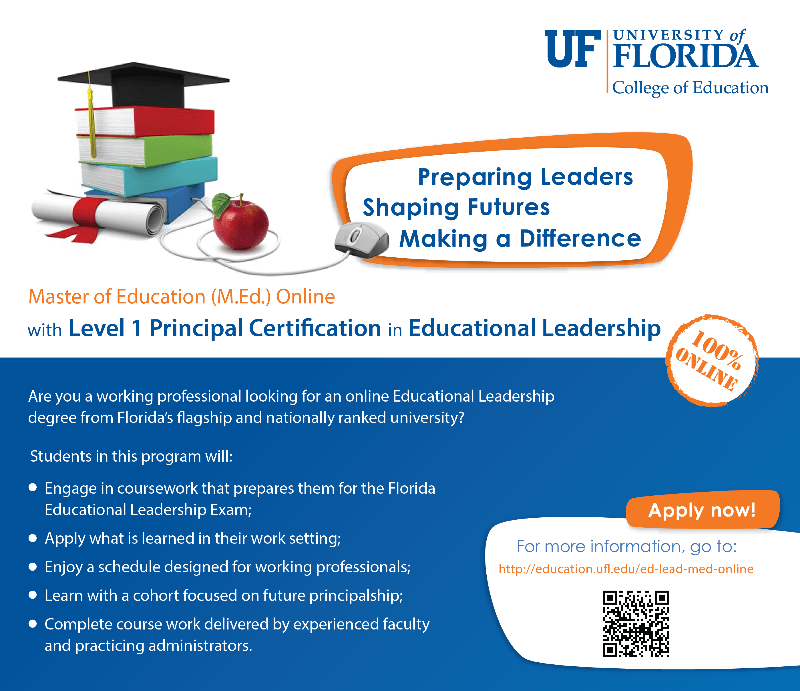
The Educational Leadership Program Area of the College of Education at the University of Florida is pleased to announce an opportunity for persons who are interested in obtaining a master’s degree with Level 1
Florida principal certification. This program from the nationallyrecognized UF Educational Leadership program is totally online and designed for working professionals. It leads to a M.Ed. and Level 1 principal certification. This program is a tremendous opportunity forpersons in your school district to further their own professional goals while the district benefits by having highly trained candidates for administrative positions.
Please review the attached flyer below and also please forward this message to the person in your district responsible for professional development and to any professionals who would be interested in obtaining a M.Ed. with certification.
Further details about the program are available at
http://education.ufl.edu/educational-leadership/online-degrees/edlead-med/
or by contacting the program coordinator,
Dr. Bruce Mousa at bmousa@ufl.edu.
 Dr. Jason Dean Arnold